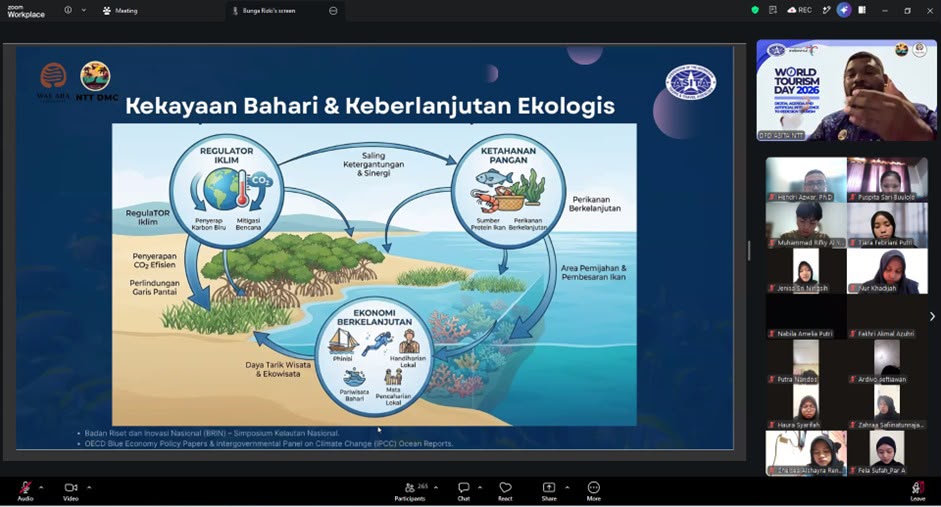
KUPANG, September 21, 2026 — Chairman of The Regional Executive Board of the Association of the Indonesian Tours and Travel Agencies of East Nusa Tenggara (DPD ASITA Nusa Tenggara Timur/DPD ASITA NTT), Oyan Kristian, ST, who also serves as President Director of NTT DMC & WAE ARA VILLA, was a featured speaker in an online technical training session titled “Digital Tourism Promotion: Insights and Best Practices.”
The session was part of the 2026 Online Training and Technical Guidance Program for Tourism and Creative Economy Human Resource Capacity Development, organized by the East Nusa Tenggara Provincial Government under the theme “Tourism Management and SAPTA PESONA for Tourism Destination Managers.”
The program was designed to strengthen the capacity and quality of human resources in the tourism and creative economy sectors, particularly those involved in managing tourism villages and destinations across East Nusa Tenggara.
More than 100 tourism stakeholders from across Nusa Tenggara Timur participated in the online training, representing various tourism destinations, businesses, communities, and other stakeholders in the province.
Digital Promotion as a Strategic Tool for Tourism Villages
During his presentation, Oyan Kristian emphasized that digital technology has fundamentally changed the way travelers search for information, discover destinations, and make travel decisions.
According to Oyan, having an attractive tourism product is no longer enough. Destination managers must also be able to communicate and market their products effectively through digital channels in order to reach their target markets.
“Today, travelers do not simply buy a destination. Before they make a decision, they buy into the information, stories, and experiences they see through digital channels. Tourism villages therefore need to communicate what they have in an attractive and consistent way while understanding the characteristics of the market they want to reach,” said Oyan Kristian.
He explained that digital promotion provides tourism villages with relatively accessible tools to introduce their products to wider audiences. Social media, websites, search engines, video platforms, and other digital channels can be used to showcase local attractions and experiences.
However, Oyan stressed that digital promotion should go beyond simply producing content or pursuing engagement metrics.
“Digital promotion is not simply about producing content regularly. What matters more is understanding who our target travelers are, what we want to offer them, what story we want to tell, and how travelers can find that information. Content needs to have a purpose and should be designed to build interest and ultimately encourage people to visit,” he explained.
Connecting SAPTA PESONA with Digital Promotion
Oyan also highlighted the importance of integrating the principles of SAPTA PESONA into destination promotion strategies.
SAPTA PESONA is Indonesia’s tourism philosophy centered on creating a positive and memorable visitor experience through seven principles: safety, orderliness, cleanliness, coolness, beauty, friendliness, and memorable experiences.
According to Oyan, these principles should not remain merely as slogans or concepts discussed during tourism training. They should be reflected in the actual visitor experience and in the way destinations communicate themselves through digital channels.
“SAPTA PESONA is actually closely connected to digital promotion. When a tourism village can demonstrate that its destination is safe, clean, welcoming, beautiful, and capable of providing memorable experiences, those qualities can become part of the story communicated to potential travelers. What we promote digitally must be consistent with what visitors actually experience when they arrive,” Oyan said.
He added that consistency between promotional messages and actual visitor experiences is essential for building a strong destination reputation. The expectations created through digital content must be matched by the quality of the experience on the ground.
Human Resources at the Heart of Digital Transformation
For Oyan, strengthening digital promotion cannot be separated from improving tourism human resources.
Technology can provide powerful tools, but its effectiveness ultimately depends on people’s ability to use those tools strategically. Tourism village managers therefore need to develop basic capabilities in areas such as digital marketing, content creation, destination branding, search engine optimization, social media, photography, video production, and the use of Artificial Intelligence (AI).
“Technology continues to evolve, but people remain the most important factor. We should not simply become technology users; we need to understand how technology can strengthen our tourism products, services, and promotion. That is why human resource development must become a long-term investment for tourism villages in NTT,” he said.
East Nusa Tenggara has significant potential to develop tourism products based on its diverse natural landscapes, cultures, traditions, culinary heritage, and authentic community experiences.
The challenge, Oyan noted, is to transform these local assets into tourism products that are ready to be marketed and communicated effectively to the right audiences.
From Local Potential to Global Markets
Oyan also encouraged tourism village managers to look beyond their immediate markets.
Digital technology allows tourism villages in East Nusa Tenggara to introduce their products to potential travelers around the world without necessarily requiring large promotional budgets.
However, he emphasized that digital promotion needs to be implemented consistently and professionally.
“Do not think that a tourism village needs to become big before it starts promoting itself. Good promotion can actually help a destination become known to the market. What matters is having a clear product, good service, a strong story, and a consistent digital presence,” Oyan said.
He further emphasized the importance of collaboration among government institutions, tourism village managers, local communities, businesses, tourism organizations, academia, and the travel industry.
Such collaboration is necessary to ensure that digital promotion does not operate in isolation, but becomes part of an integrated tourism ecosystem covering product development, service quality, marketing, and visitor distribution.
More Than 100 Tourism Stakeholders Join the Training
The online technical training, held on September 21, 2026, attracted more than 100 tourism stakeholders from across East Nusa Tenggara.
The strong participation reflects the growing need to strengthen human resource capacity, particularly in responding to changing traveler behavior and the rapid development of digital technology within the tourism industry.
Through initiatives such as this program, the East Nusa Tenggara Provincial Government is expected to continue strengthening the capacity of destination and tourism village managers, enabling local tourism potential to be managed more professionally, sustainably, and in line with market needs.
For DPD ASITA NTT, the involvement of the travel industry in human resource development initiatives is an important part of building a more integrated tourism ecosystem.
As an association representing travel businesses, ASITA NTT recognizes that destination readiness and product quality are closely connected with the ability to market and communicate tourism products effectively.
“NTT has an enormous amount of tourism potential. The challenge is not only how to bring travelers here, but also how to ensure that when they arrive, they receive a quality experience and are willing to share that experience with others. Ultimately, the best promotion is the experience itself,” Oyan Kristian concluded.
Bimtek Presentation Materials Available Online
The presentation materials for “Digital Tourism Promotion: Insights and Best Practices,” delivered by Oyan Kristian, are available for tourism stakeholders and the public to access and download through the official ASITA NTT website, under the Documents section.
The materials are expected to serve as an additional reference for tourism village managers, tourism businesses, communities, and other stakeholders seeking to develop more effective digital tourism promotion strategies.
About DPD ASITA NTT
DPD ASITA NTT is the regional organization representing travel agencies and tourism businesses in East Nusa Tenggara. The organization is committed to strengthening professionalism within the travel industry, developing networks among tourism stakeholders, and supporting high-quality, sustainable, inclusive, and competitive tourism development across East Nusa Tenggara.